

Thoughts & Musings
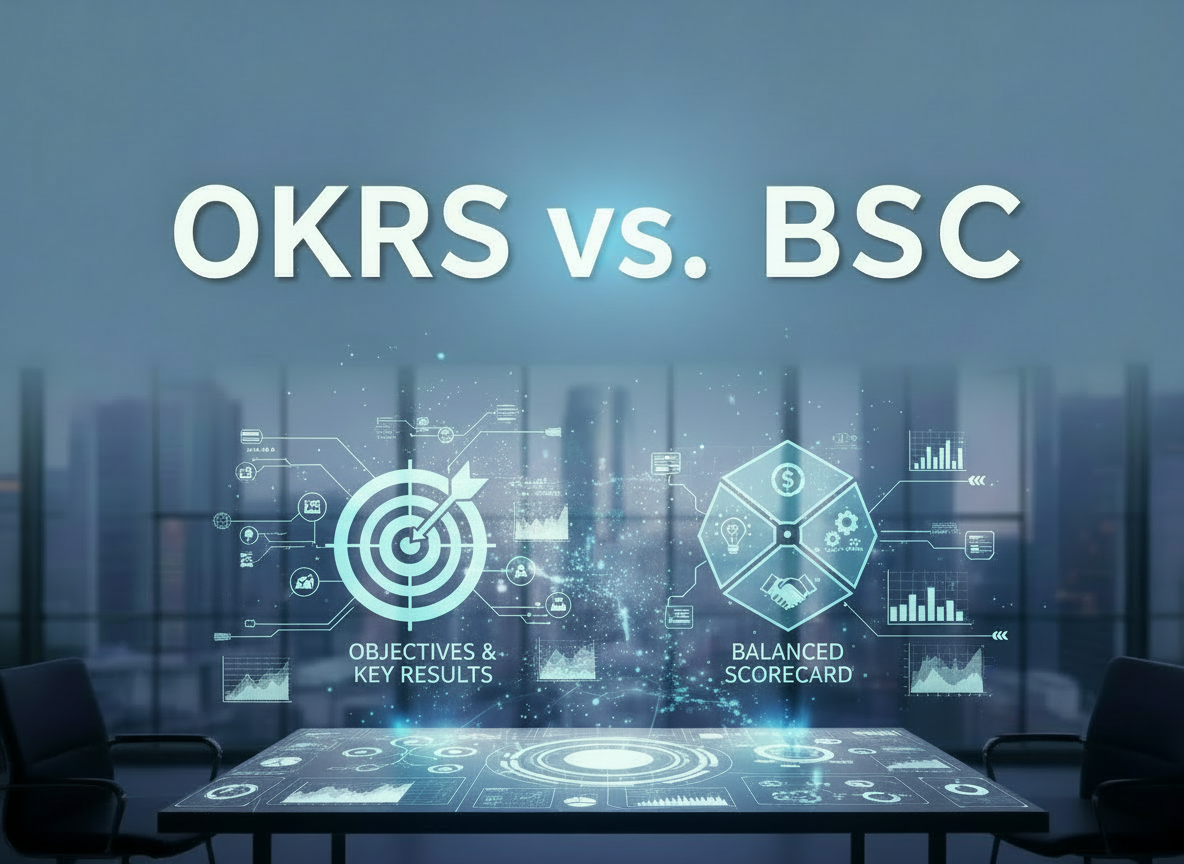
OKRs vs the Balanced Scorecard
OKRs vs the Balanced Scorecard - Comparing Strategy Execution Frameworks: Two Frameworks, One Challenge
In our previous article, we argued that comparing OKRs to KPIs represents a category error—akin to comparing a vehicle with a speedometer. The more meaningful comparison, we suggested, is between OKRs and the Balanced Scorecard: two genuine strategy execution frameworks that occupy the same conceptual space and address the same fundamental challenge for the firm.
That challenge is as old as strategic planning itself: how to translate high-level strategic intent into aligned, measurable action throughout the firm. Research consistently demonstrates that the majority of strategies fail not in formulation but in execution. The gap between boardroom aspiration and frontline reality has been the graveyard of countless strategic initiatives.
Both OKRs and the Balanced Scorecard emerged as responses to this execution gap. Both provide structured approaches for setting objectives, measuring progress, and aligning the firm's effort. Both have been adopted by thousands of firms worldwide. And both have passionate advocates who argue for the superiority of their preferred approach.
In this article, we shall examine both frameworks in depth, compare their philosophies and mechanics, and offer guidance on which might be better suited to different firms’ contexts. This is not a competition to declare a winner; both frameworks have proven their worth across diverse settings. Instead, it is an analysis to help firms make informed choices about their strategy execution approach.
OKRs vs KPIs: A Comparison That Misses the Point
OKRs vs KPIs: A Comparison That Misses the Point
The Proliferation of a Flawed Debate
A cursory search of business publications, management blogs, and consulting whitepapers reveals a curious preoccupation: the comparison of OKRs and KPIs. "OKRs vs KPIs: Which is Right for Your Organisation?" "KPIs or OKRs: Choosing the Best Goal-Setting Framework." The articles proliferate, each offering frameworks for decision-making, comparison tables, and recommendations for when to use one versus the other.
Yet this entire discourse rests upon a flawed premise. Comparing OKRs and KPIs is rather like comparing a vehicle and a speedometer. One is a complete system designed to achieve a purpose; the other is a measurement instrument that can be employed within that system or indeed within many others. The question is not which to choose, but rather how each serves its distinct purpose and how they might be deployed together.
This distinction matters because firms that misunderstand it risk making poor decisions about their performance management architecture. They may adopt OKRs believing they have replaced their need for KPIs, only to find themselves lacking the operational measurements necessary for day-to-day management. Alternatively, they may resist OKRs believing their existing KPIs are sufficient, failing to recognise that KPIs alone, however well-constructed, do not constitute a strategy execution framework.

What Are OKRs? A Framework for Strategy Execution in Modern Firms
What Are OKRs? A Framework for Strategy Execution in Modern Firms
The Challenge of Strategic Execution
Consider a question that has vexed senior management teams for decades: why do so many well-crafted strategies fail in execution? Research consistently demonstrates that between 60 and 90 percent of strategic initiatives fall short of their intended outcomes. The strategy may be sound, the resources adequate, and the leadership committed, yet somewhere between boardroom formulation and frontline execution, the thread is lost.
This failure is not for want of trying. Firms invest substantial resources in strategic planning processes, often engaging consultants and dedicating significant management time to crafting mission statements, vision documents, and strategic plans. Yet these same firms frequently struggle to translate high-level strategic intent into measurable, actionable goals that employees at all levels can understand, embrace, and execute.
It is within this context that Objectives and Key Results, commonly known as OKRs, have emerged as a powerful framework for bridging the gap between strategy formulation and strategy execution. But what exactly are OKRs, and why have they gained such prominence in firms ranging from technology giants to traditional manufacturing firms?
The Origins and Evolution of OKRs

From VUCA to STORM
Why the Old Frameworks No Longer Fit the Exponential Age
The End of an Era
For nearly four decades, leaders relied on VUCA—Volatility, Uncertainty, Complexity, and Ambiguity—to describe and navigate disruptive environments. Developed by the United States Army War College in the late 1980s to describe the post-Cold War world, VUCA became the dominant framework for understanding turbulent business conditions.
VUCA served its purpose well. It helped leaders recognise that stability was an illusion, that planning required scenarios, that organisations needed flexibility, and that clear communication mattered amid confusion.
But by 2016, VUCA no longer reflected reality. The framework was built for a world of occasional disruption within broadly stable systems. What emerged instead was something more fundamental: a structural transformation of how change itself operates.
Why VUCA Is No Longer Sufficient

Leading Through the STORM
Strategy in an Age of AI, Quantum, Robotics, and Fusion
The Decade That Changed Everything
The decade from 2016 to 2025 has witnessed disruption unlike anything in modern business history. The Trump-era policy reversals, COVID-19 shutdowns, supply chain breakdowns, inflation shocks, the Ukraine war, and the rise of artificial intelligence have fundamentally reshaped what it means to lead a firm.
Yet these disruptions, significant as they have been, represent merely the opening chapters of a far more profound transformation.
The next two to five years will deliver quantum computing, advanced robotics, autonomous systems, and potentially commercial nuclear fusion—each with the potential to upend entire industries and alter geopolitical power balances. We are entering an era not simply of volatility, but of something more fundamental: a structural shift in how change itself operates.
This is the era of STORM: Speed, Turbulence, Opposition, Reversals, and Magnification.
The STORM Framework Explained

Build your risk register based on events
A crucial part of the risk management process should be continuously reviewing events and identifying risks that materialised but were not already on the risk register. Firms should also use events to trigger the closing of risks that may no longer be relevant.
Woodford's return and the SM&CR

High-quality conversations informed by data, information and analytics.
It is about high-quality conversations informed by data, information and analytics.

Risk-Taking Boundaries – A Risk Appetite and Risk Capacity Primer
In this article, I am going to introduce two important concepts related to setting boundaries for risk-taking and seek to clarify there meaning. These two concepts are Risk Appetite and Risk Capacity.

Probability of Execution (POE)
The Probability of Execution is an aggregated, easy to understand percentage value showing the probability that a single objective, or group of objectives will be executed by its due date based on the various data points which have a causal relationship to the objective. This includes linkages between objectives and aligned processes and initiatives, and of course, risks and controls at various levels within the RBPM framework.